 labahan
Operations
Laundry care label symbols explained: a guide for laundry shop staff
By the Labahan team · October 18, 2026 · 4 min read
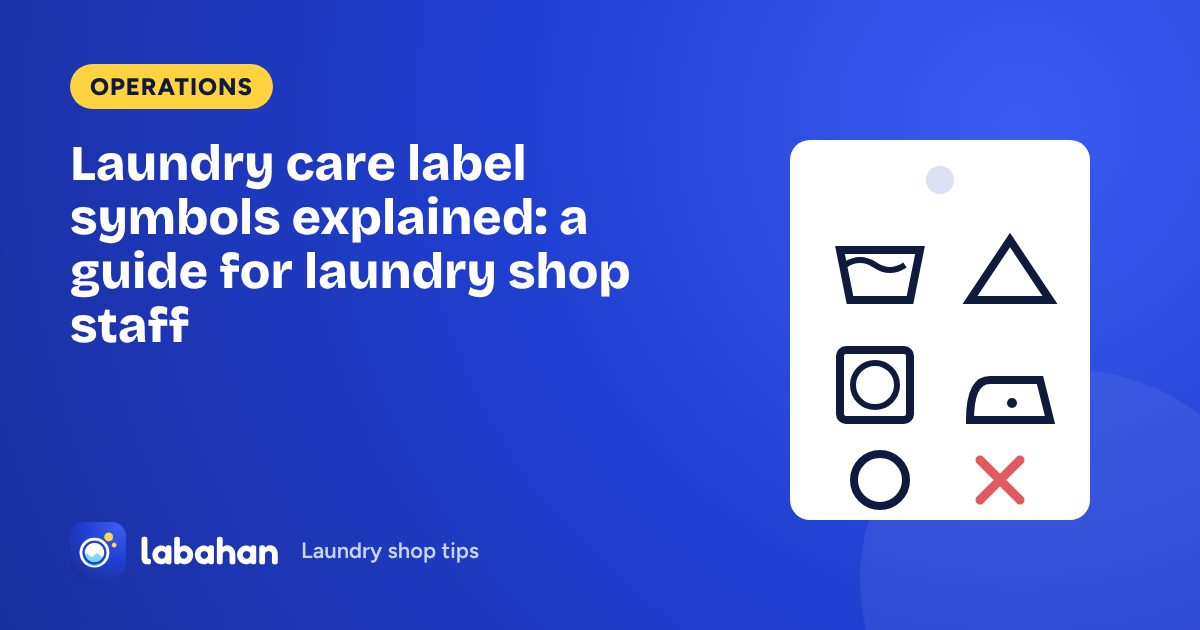
Every garment has a small tag that tells you how to wash it, but most of it is in pictures, not words. Staff who can read those pictures in two seconds ruin fewer clothes and give fewer refunds. The good news: there are only five basic symbols, plus three small marks that change their meaning.
The five symbol families
International care labels use five basic shapes, one for each step of caring for an item. This guide follows the system described by GINETEX, the international association for textile care labelling, and the American Cleaning Institute’s symbol guide.
Washing
Bleaching
Drying
Ironing
Pro cleaning
Three marks that change the meaning
Bars under a symbol = gentler. One bar is a milder cycle, two bars very mild.
An X over a symbol = don’t. Do not wash, do not bleach, do not tumble dry, and so on.
1. Washtub: washing
The tub with water at the top means the item can be machine washed. Labels made to the international (ISO) system often print the maximum water temperature in °C inside the tub, such as 30, 40 or 60. Labels made for the US use dots instead: one dot is cool water, and more dots mean hotter water. A hand in the tub means hand wash only.
| Symbol | What it means for your shop |
|---|---|
| Number in the tub Wash at no more than this temperature (here 30 °C). Most shop loads in cold or cool water are fine. | |
| One dot Cool wash. More dots mean warmer water is allowed. | |
| One bar under the tub Milder cycle with less spinning and agitation (for example, synthetics or “easy care”). | |
| Two bars under the tub Very gentle cycle, such as a wool program. Use a mesh bag and a small load. | |
| Crossed tub Do not wash. Don’t put it in your washers. Set it aside and call the customer. |
2. Triangle: bleaching
| Symbol | What it means for your shop |
|---|---|
| Empty triangle Any bleach is allowed, including chlorine bleach. | |
| Triangle with two lines Only oxygen or non-chlorine bleach. No chlorine (no “clorox”-type bleach). | |
| Crossed triangle Do not bleach. Use a regular detergent without bleach. |
Chlorine bleach on the wrong fabric can leave yellow or pale patches that cannot be fixed, so this symbol matters even if you only bleach whites.
3. Square: drying
The square is about drying. A circle inside the square means tumble drying, which is what your dryers do. Dots inside the circle show the heat: GINETEX lists normal tumble drying at up to 80 °C and a milder, lower-heat setting at up to 60 °C. Lines inside the square (with no circle) mean natural drying.
| Symbol | What it means for your shop |
|---|---|
| Circle with one dot Tumble dry on low heat. | |
| Circle with two dots Tumble dry on normal heat. | |
| Crossed tumble dry Do not tumble dry. Air-dry it instead, or call the customer if you can’t. | |
| Line in the square Line dry (hang it). US-style labels may draw the line-dry mark differently, but it is still a square with a line. | |
| Flat line in the square Dry flat, for knits and sweaters that stretch when hung. |
4. Iron: ironing
The dots on the iron show the maximum heat. GINETEX’s table gives sole-plate limits of about 110 °C (low), 150 °C (medium) and 200 °C (high).
| Symbol | What it means for your shop |
|---|---|
| One dot Low heat, about 110 °C. Synthetics such as nylon and acetate. No steam. | |
| Two dots Medium heat, about 150 °C. Wool, silk, polyester. | |
| Three dots High heat, about 200 °C. Cotton and linen. | |
| Crossed iron Do not iron. |
5. Circle: professional cleaning
A plain circle is for professional cleaners. The letter inside tells a dry cleaner which process and solvent to use, and a bar under it means a gentler process. For a laundry shop, the key point is simple: an item with a circle symbol and a crossed washtub is meant for a dry cleaner, not your washers.
| Symbol | What it means for your shop |
|---|---|
| Circle with a letter Professional cleaning (dry cleaning or professional wet cleaning). Not a machine-wash item unless the tub symbol also allows it. | |
| Crossed circle Do not dry clean. Usually fine to wash as the tub symbol says. |
US labels and international labels
Clothes sold in the Philippines come from many countries, so you will see both styles. The US Federal Trade Commission notes that the US (ASTM) and international (ISO) symbols are “similar, but not identical”. The main differences your staff will notice: numbers versus dots in the washtub, and the line-drying mark. The five shapes and the dot, bar and X rules work the same way.
A quick routine for the sorting table
- Crossed washtub: set aside, call the customer
- Two bars: gentle cycle, mesh bag, small load
- Crossed tumble dry: air-dry only
- Crossed triangle: no bleach in that load
- Wash cold on a gentle cycle
- Ask the customer before you start
- Write the special care on the stub
Care labels are one part of the checks before washing. See the full pre-wash checklist.
How Labahan helps
Labahan Manager doesn’t read care labels for you. It does let you set up separate services and add-ons once (for example, a gentle or hand-wash service at its own price), so staff charge the same way every time, and the app’s in-app lessons and printable staff handbook help new staff learn your shop’s routine.